
Costela is beef ribs, and in Brazil it is one of the great churrasco cuts. It is not a rub, a smoker at 250°F (120°C), twelve hours, and a bark.
Safety instructions
Rare beef at 125 to 130°F (52 to 54°C) is below the USDA 145°F (63°C) finish. Buy whole muscle from a butcher or a named packer, and sear the outside. Higher-risk people should wait for 145°F (63°C). Ground beef stays 160°F (71°C).
At a glance
- Region: Sul
- Distance: 40–50 cm (16–20 in) from the embers
- Time: about 3 to 5 hours for a plate-rib slab, not a 12-hour wrap
- Yield: one 4 to 6 lb (1.8 to 2.7 kg) slab feeds 4 to 6 as the main cut
- Ask for: plate short ribs or long bone-in beef ribs. The case may say short plate ribs or dino ribs.
Shop links on this page: I may earn a commission. Same price for you. As an Amazon Associate I earn from qualifying purchases.
What costela means
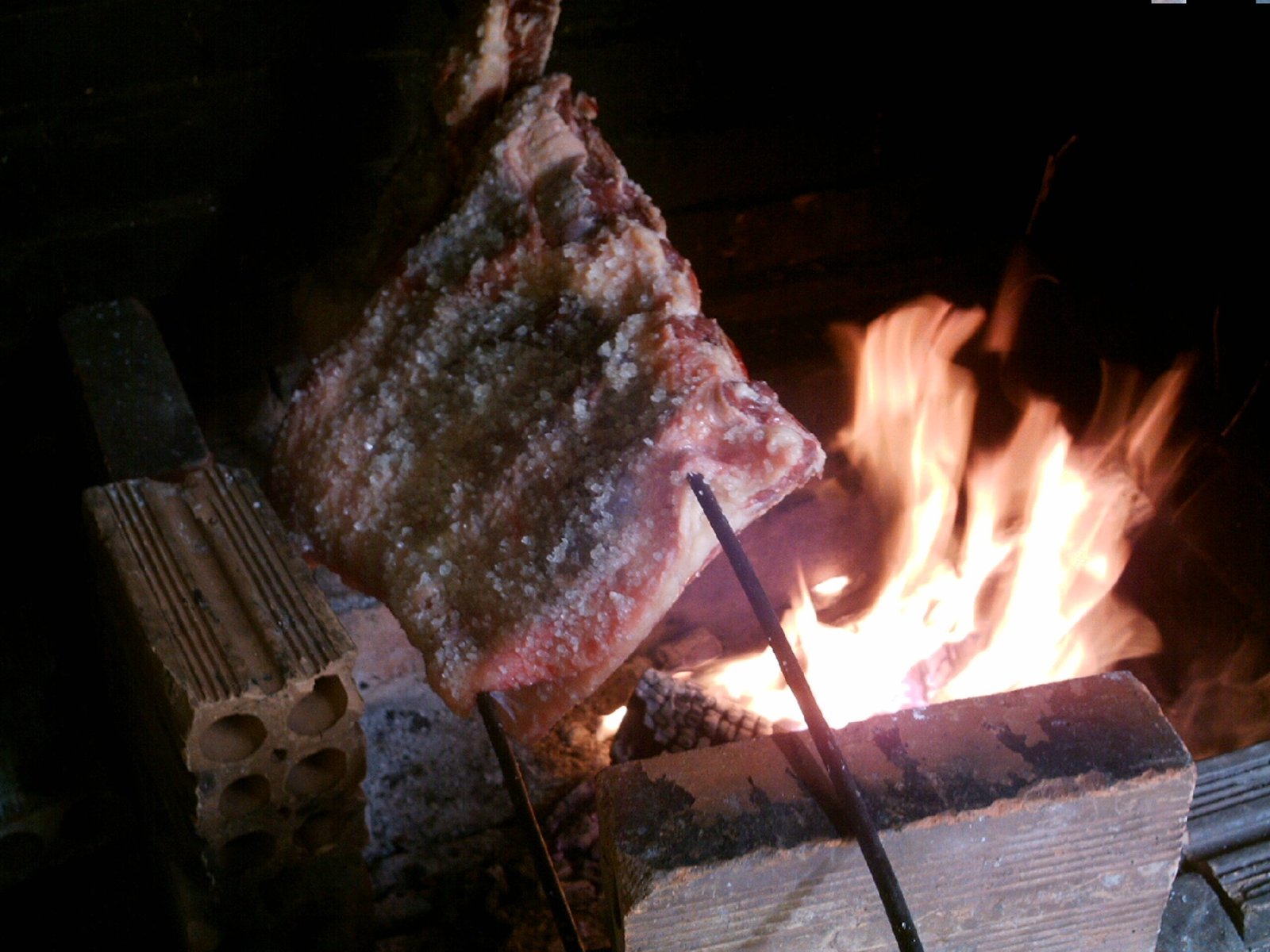
Costela is the rib section, cooked in large pieces rather than trimmed into individual portions. In the traditional gaucho form, costela de chao or fogo de chao, whole slabs are mounted on iron stakes driven into the ground around an open wood fire and cooked for many hours by radiant heat, turned occasionally, salted with coarse salt.
On a conventional churrasqueira, costela is cooked over embers on a grate or a heavy skewer, usually a few hours, well above the coals. Either way, the heat source is fire and embers in the open, not enclosed smoke.
Keep the slab 40–50 cm (16–20 in) from the embers. See how far picanha sits from the charcoal.
How it differs from Texas barbecue
Texas beef ribs are cooked in a closed smoker at a controlled low temperature, with wood smoke as a deliberate flavor. They are usually rubbed with salt and coarse black pepper, sometimes more, and taken well past the point where collagen has fully broken down, into the range where the meat pulls apart.
Costela is cooked in the open, seasoned with coarse salt only, and is generally not taken to the same falling-apart texture. It is tender and it slices, and it keeps more of a roasted, fire-cooked character than a smoked one. The exterior is browned, not barked.
Both are good. They are different dishes.
What to buy in the US
Costela here is one whole slab of ribs, still on the bone, not a few short pieces and not a stew cut. When you go to the butcher, say you want plate short ribs or long beef ribs, bone in. The case is also labeled short plate ribs or dino ribs. A real slab is three long bones, four to six pounds, with a thick meat cap over the bones. If they only know English names, those two will get you the slab. Show them a photo of a long rack if the names do not land. Brisket and thin flanken strips cut across the bone are other cuts.
Beef chuck short ribs are more common and will work, though they are smaller and the meat is distributed differently. Back ribs have very little meat and are not worth this method.
Take the slab whole. A cut between the bones is a different cook. Leave the fat on and leave the membrane on the bone side, since over a long open-fire cook it protects the meat.
Seasoning
Coarse salt on all surfaces, applied before it goes on the fire, heavier than for a fast cut because the cook is long. Measure it: up to 30 g of sal grosso per quilo (about 2 colheres de sopa, 2 tablespoons, per 1 kg/ 2.2 lb), against the 1 colher de sopa per quilo used for quick cuts like picanha. In the US, 1 tablespoon Morton kosher or 1 1/2 tablespoons Diamond Crystal stands in for each tablespoon of sal grosso, still per quilo. Nothing else. Knock the excess off before slicing, which is why the coat looks heavy going on.
Cooking it at home
This is a longer cook than picanha, which takes half an hour, and a shorter one than Texas ribs. Plan on roughly three to five hours for a plate rib slab, depending on size and fire. Leave it unwrapped so the surface can color.
On a kettle grill, build a two-zone fire with all the coals banked to one side. Use lump charcoal (100% wood lump), not briquettes. Put the slab on the cool side, bone side down, and cook with the lid on and vents open. You are aiming for something in the range of 275 to 325°F at the grate, which is hotter than Texas practice and closer to the open-fire feel. Add a chimney of fresh lump every hour or so to hold it.
Turn the slab occasionally. If the meat side is drying, keep it bone-down longer. Foil steams away the surface you are trying to build.
Judge by feel and temperature together. Costela is ready when a probe slides into the meat between the bones with little resistance. Start checking at 195°F. It often lands around 200 to 205°F internal, but it should still slice, not shred. Feel matters more than the number.
On the table
Rest twenty to thirty minutes loosely tented on a cutting board. Then cut between the bones into individual ribs, or slice the meat cap across the grain with a long flat slicer and serve it off the bone.
Serve with farofa, vinagrete, and rice. No sauce. A rib that needs sauce was cooked wrong.
Whether it is worth it at home
Costela is a project. It occupies the grill for most of an afternoon and it does not fit alongside a fast picanha cook on the same kettle grill. If the table is eight people and wants variety, picanha and fraldinha are the better use of the fire. Save costela for a day when it is the only thing on the grate.
What to buy
A long open fire: heavy salt, a bag of lump that lasts, and a probe you can leave in. The usual mid is the one to get first. The full kit is on What to buy.
Salt
- Low: Morton Coarse Kosher — the box that always works on the fire.
- Usual mid: Diamond Crystal kosher — lighter crystals, easier to knock off after the cook. A Brazilian-market bag of sal grosso is better when you find it.
- High: Cisne Sal Grosso — the Brazilian rock salt this fire was built around.
Charcoal
- Low: a named lump bag that lights clean in a chimney.
- Usual mid: Jealous Devil lump.
- High: FOGO Premium lump. Dense pieces that last.
Thermometer
- Low: ThermoWorks ThermoPop 2 — fast enough to pull beef and to know a thigh hit 165°F (74°C).
- Usual mid: CHEF iQ Sense — wireless leave-in for the long costela cook.
- High: ThermoWorks Thermapen ONE — for spot checks on slices.
Next cooks
- How to run a two-zone fire on a Weber kettle grill
- How far should picanha sit from the charcoal
- Costela seasoned with sal grosso only
- How much meat to buy for a Brazilian barbecue
Region: Sul.
Leave a Reply