
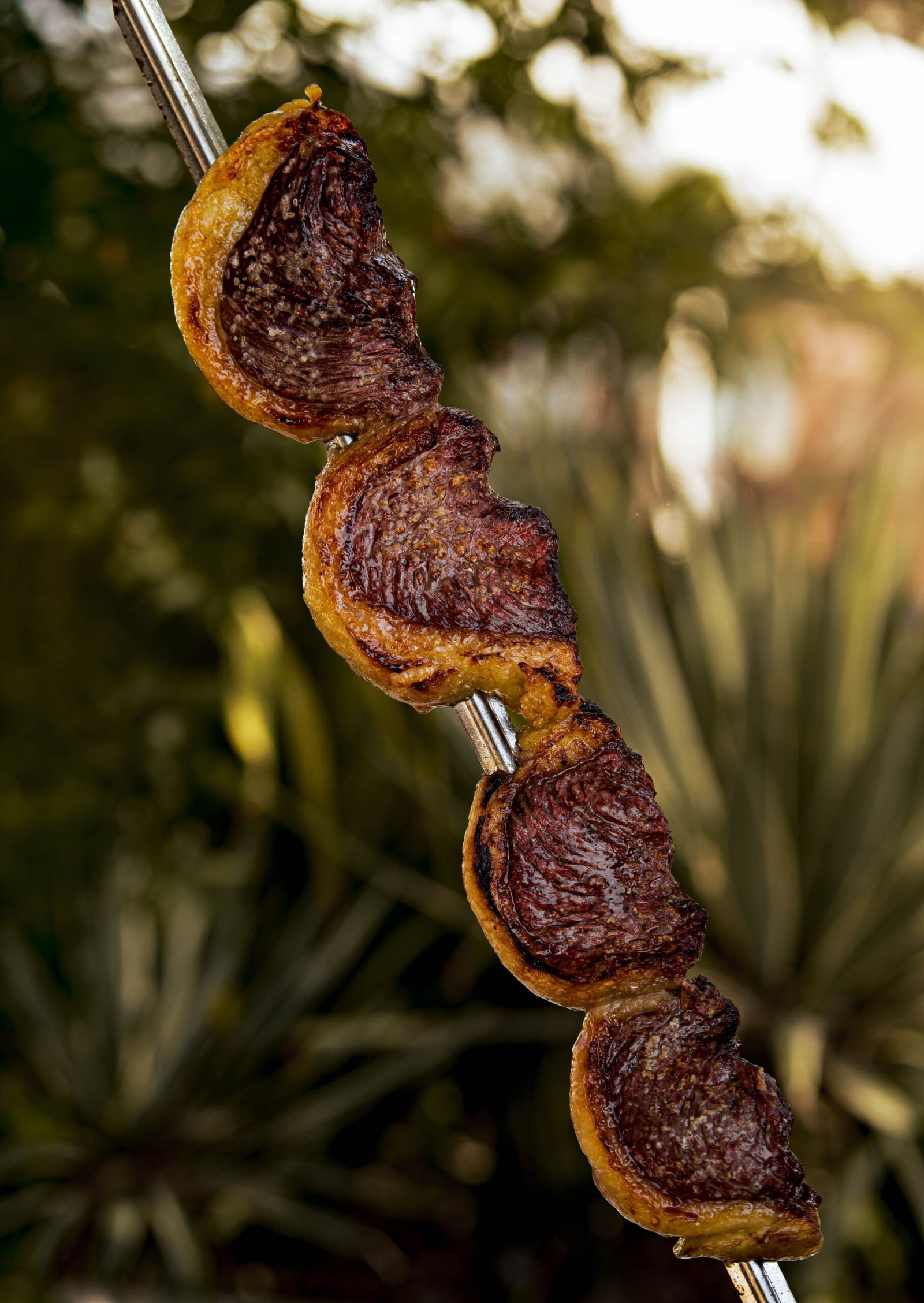
Top sirloin cap (picanha) is also sold as coulotte or rump cap. Ask the butcher for top sirloin cap, and leave the fat cap on. Many Costco, Sam’s, Walmart, and Brazilian or Latin shops now label it picanha. Those warehouse packs are easy to find. They are not as high quality as a butcher piece or a named shipper. If you cannot get the cap, a thick top sirloin steak with a fat edge is the fallback. It is not as good.
Shop links on this page: I may earn a commission. Same price for you. As an Amazon Associate I earn from qualifying purchases.
Safety instructions
Rare beef at 125 to 130°F (52 to 54°C) is below the USDA 145°F (63°C) finish. Buy whole muscle from a butcher or a named packer, and sear the outside. Higher-risk people should wait for 145°F (63°C). Ground beef stays 160°F (71°C).
One of the most frequent questions on grilling with skewers is how far the meat should be from the fire. It is the right question, because on a churrasqueira distance is the control. There is no knob. The meat moves.
The geometry is different from a grill
On a typical backyard grill, food sits on a grate a fixed few inches above the heat and you manage the cook by timing and by moving side to side. On a Brazilian churrasqueira, the meat hangs on a long skewer beside or above a bed of glowing embers, and the rack the skewer rests on has multiple heights.
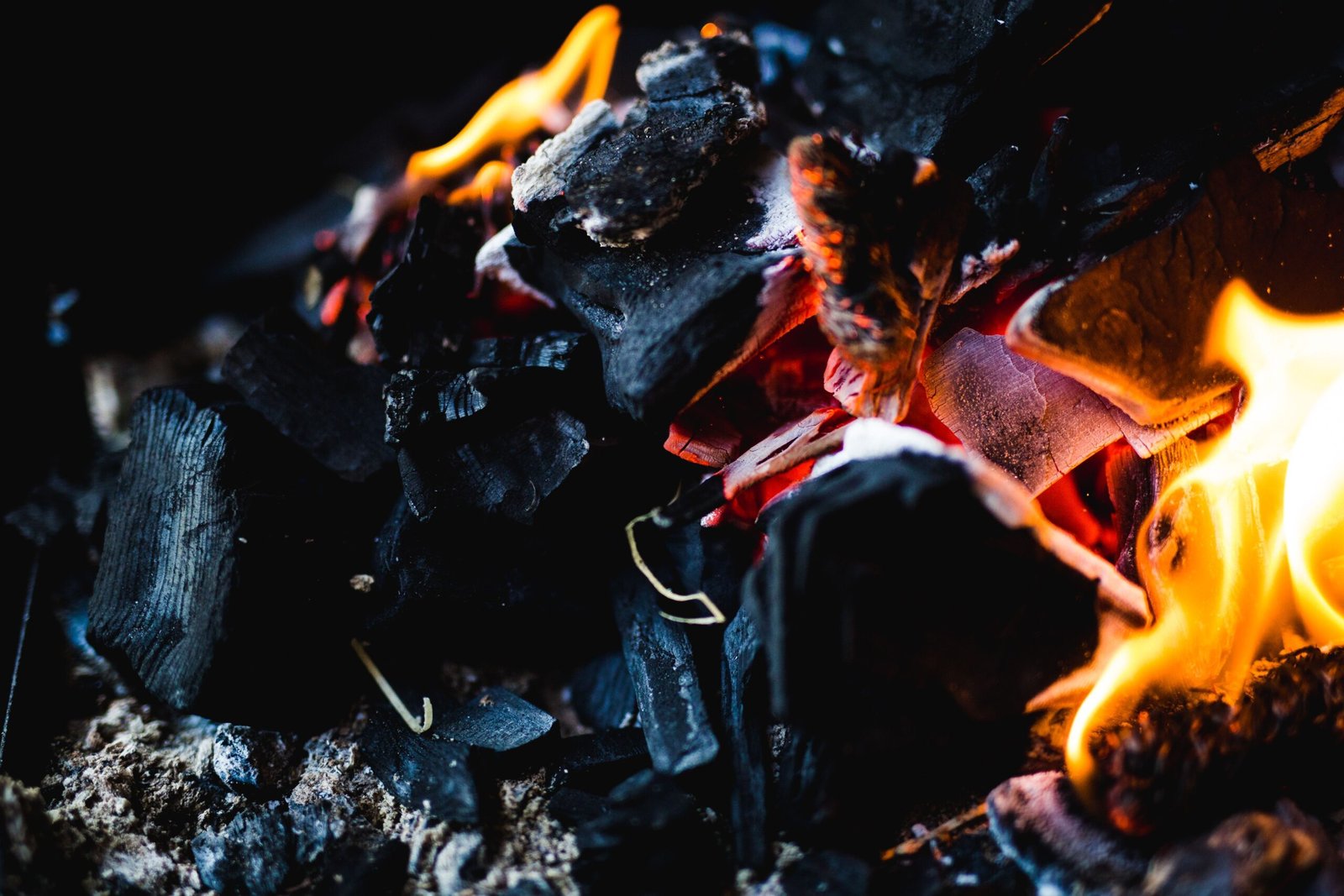
Two things follow from that. The meat is not sitting on a grate like a burger, so it is not conducting heat from hot metal, it is receiving radiant heat from embers. The meat sits over embers, not flames. Brasa means embers, and if there are flames licking the meat, something is wrong with the fire or the fat is dripping in the wrong place.
How far
On the skewer, start picanha about 20 cm (8 in) from the embers to take color, then raise it to about 40 cm (16 in) to finish. A whole piece sits about 40 cm (16 in). Steaks on a grate sit about 20 cm (8 in). That is where most of a picanha cook happens.
- Picanha on the skewer: 20 cm (8 in) to take color, then 40 cm (16 in) to finish
- Picanha whole piece: about 40 cm (16 in)
- Picanha steaks on a grate: about 20 cm (8 in)
- Alcatra, maminha, fraldinha, other thick beef: 30–40 cm (12–16 in)
- Costela, cupim, long cooks: 40–50 cm (16–20 in)
- Linguiça: 35–40 cm (14–16 in)
- Galeto: 25 cm (10 in). Hand test about 7 seconds
- Chicken hearts, wings, gizzards: 20–30 cm (8–12 in)
- Kettle grill grate: often about 10 cm (4 in), so two zones do the raise
Other thick beef — top sirloin roast (alcatra), tri-tip (maminha), sirloin flap (fraldinha) — sits 30–40 cm (12–16 in) from the embers. Beef plate ribs (costela) and zebu hump (cupim; no true US cut), the long cooks, go 40–50 cm (16–20 in).
The distance depends on how hot your coals are, how deep the bed is, and how thick the meat is. A shallow, cooling bed needs the meat closer. A deep bed of freshly poured lump needs it farther away. Treat those numbers as a starting point, not a specification.
The hand test
Distance is a proxy for heat, and heat is what you actually want to measure. The hand test does that directly and it costs nothing.
Hold your open palm at the height the meat will sit, facing the embers, and count. If you have to pull away at two to three seconds, that is the right intensity for building a beef crust. If you cannot hold it for one second, you are too close and the outside will burn before the inside is done. If you can comfortably hold it for six or more, the fire is too weak or the meat is too far out, and you will dry the beef before you brown it.
Do the test at the meat’s actual position, not over the middle of the fire. The edges of a bed are always cooler than the center.
Fat cap first, then adjust
Start with the fat cap facing the heat. Rendering the cap is the first job, and it takes the most sustained exposure. As the fat softens and begins to run, it will drip toward the coals.
If fat ignites and flames start reaching the meat, raise the skewer. That is the whole correction. Move the meat, and wait. Water, blowing, and pushing through a burn make it worse. Flames deposit soot and burnt fat, which tastes acrid and is not the same thing as crust. Crust comes from dry radiant heat browning a surface. Char from flame is a defect.
Once the flare settles, bring the skewer back down. Over a thirty minute picanha cook you may move the skewer up and down several times. That is normal and it is the technique working.
The kettle grill version
On a Weber kettle grill you cannot meaningfully vary the distance to the coals, because the grate height is fixed. That grate often sits around 10 cm (4 in) from the coals, closer than the Brazilian target, so two zones do the work of raising the meat. The hand test is closer to how the meat feels than a tape on the coals. Use a two-zone fire instead, which achieves the same result by a different route.
Bank all the coals to one half of the charcoal grate and leave the other half empty. Sear over the hot pile, and move the meat to the empty side to finish or whenever fat starts to flare. Moving a steak from the hot side to the cool side is the same decision as raising a skewer: you are cutting incoming radiant heat without touching the fire.
The hand test still applies. Two to three seconds over the coals, five or more over the empty side.
What transfers
Restaurant rotisseries vary. Those factory numbers are not the backyard numbers. What transfers is embers, not flames, and distance as the control.
Long flat sword skewers make this practical, since they hold the meat steady and keep your hand away from the fire. A chimney starter and lump charcoal get you a proper ember bed. An instant-read thermometer tells you when the inside is done while you are managing the outside.
What to buy
Distance only works if the bed is real embers and the skewer holds. The full kit is on What to buy.
Charcoal
- Low: Royal Oak 100% hardwood lump that lights clean in a chimney.
- Usual mid: Jealous Devil lump.
- High: FOGO Premium lump. Dense pieces that last.
Chimney
- Low: Kingsford Heavy Duty chimney starter.
- Usual mid: Weber Rapidfire 7416 chimney starter.
Skewers
- Low: Flat stainless supermarket skewers. Flat so the meat does not spin. Skip thin round kebab sticks.
- Usual mid: JOWHONK flat stainless skewers, 27 in long and 1 in wide.
- High: A simple espeto set from a Brazilian shop. Plain blades.
Thermometer
- Low: ThermoWorks ThermoPop 2.
- Usual mid: CHEF iQ Sense — wireless leave-in probe + hub.
- High: ThermoWorks Thermapen ONE — fast instant-read.
Next cooks
- Two-zone fire on a kettle grill
- How to grill picanha on a kettle grill
- Types of Brazilian barbecue grills
- Fogo de chão
Region: Across Brazil.
Leave a Reply