
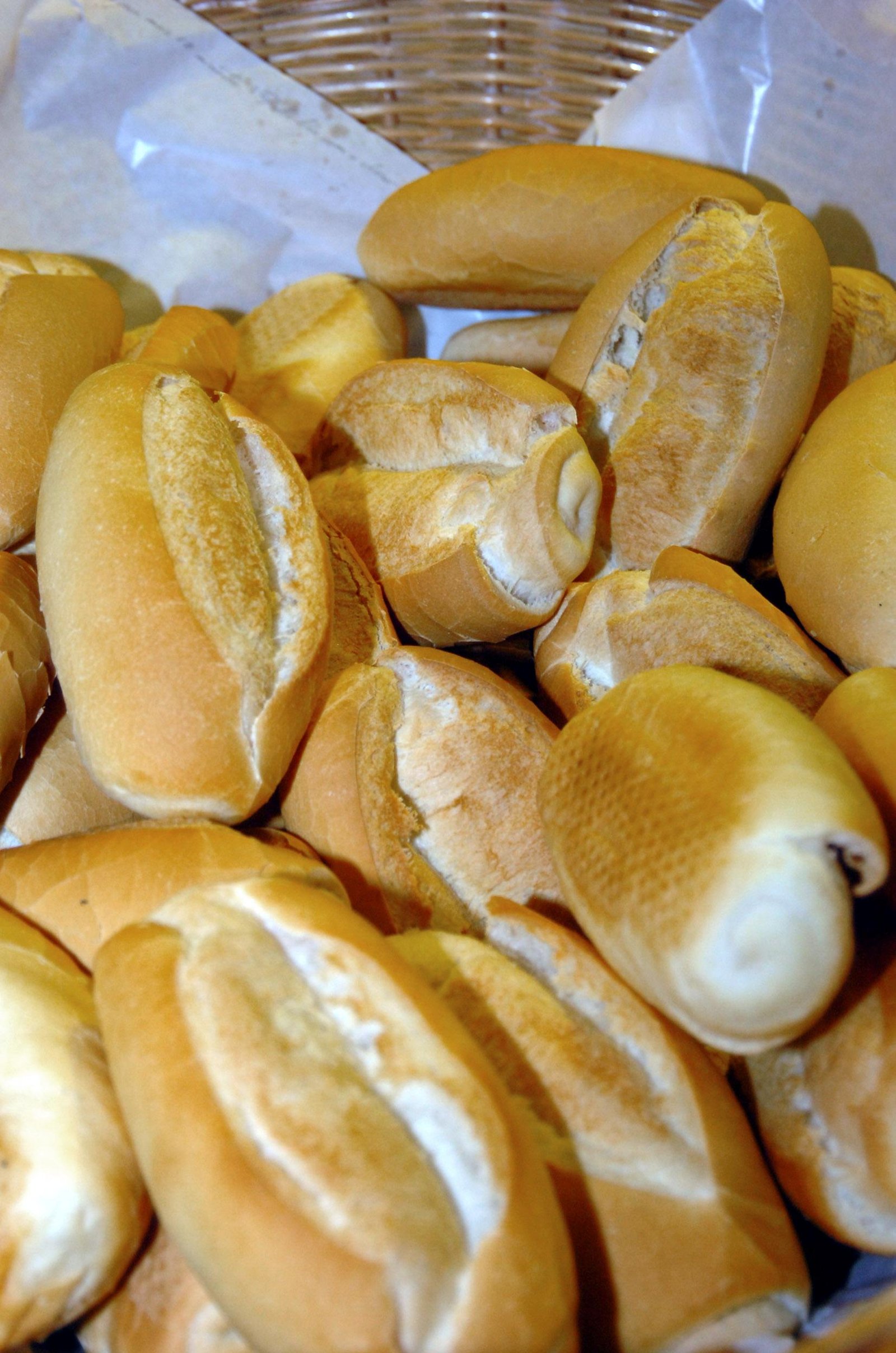
Pão francês is the everyday Brazilian bakery roll: a thin, crisp crust and a soft crumb. It is the bread for a steak sandwich and for pão de alho. It is not a baguette. These are small rolls, about 10 cm (4 in), with tapered ends and a split on top.
The same roll is also called cacetinho. A padaria dough is lean: flour, water, yeast, and salt. A home oven does not inject steam the way a bakery oven does. A little sugar and oil in this batch help the crust take color and keep the crumb soft. That is the home method, not a different bread.
Where to buy it
Start at a Brazilian bakery if the town has one. Ask for pão francês or cacetinho. The roll should give a little when squeezed and should not be a long baguette.
If that bakery is empty, a Mexican bakery is the next stop. Bolillo is the closest US shop roll: a short oval, thin crust, soft middle. A Portuguese roll is next. A soft kaiser is last.
Skip a supermarket baguette and skip a hamburger bun. One is too hard. The other is too soft and sweet.
What to buy
- Low: bolillo from a Mexican bakery, used the same day
- Usual mid: these rolls baked at home
- High: pão francês from a Brazilian bakery the morning of the fire
Ingredients (12 small rolls)
- 4 cups (500 g) bread flour. Unbleached all-purpose works if that is what is in the bin
- 1 1/4 cups (300 ml) room-temperature water
- 1 tablespoon (10 g) instant yeast
- 2 teaspoons (10 g) fine salt
- 2 teaspoons (10 g) sugar
- 4 teaspoons (20 ml) neutral oil
- Fine cornmeal or extra flour for the pan (fubá in a Brazilian kitchen)
Method
- Mix the flour, salt, and sugar in a bowl. Add the yeast and the water. Mix until a shaggy dough forms, then add the oil.
- Knead on a clean counter for about 15 minutes, until the dough is smooth, elastic, and only a little tacky. A mixer with a dough hook takes about 8 to 10 minutes. The dough should stretch thin without tearing (the veil point). This dough is firmer than a ciabatta. If it is wet and slack, add a spoon of flour. If it is stiff as clay, wet the hands and keep kneading.
- Form a ball. Put it in a lightly oiled bowl. Cover. Let it rise until doubled, 40 to 50 minutes.
- Turn the dough out and press the air out gently. Divide into 12 pieces, about 2 oz (55 to 70 g) each. Cover the pieces so they do not dry.
- Shape each piece: flatten to a small rectangle, fold the short ends in, then roll it up tightly like a jelly roll and pinch the seam shut. Roll the piece under the palms to lengthen it to about 10 cm (4 in), with the ends a little tapered. This tight roll is what gives the bakery shape. A loose log bakes flat.
- Dust a baking sheet with cornmeal or flour. Set the rolls seam-side down, with space between them. Cover loosely. Let them puff 30 to 40 minutes, until a finger dent springs back slowly.
- While they rise, heat the oven as hot as it goes, up to 480°F (250°C), for at least 20 minutes. A pizza stone or an inverted metal sheet on the middle rack should heat with the oven. Put an empty metal pan on the lowest rack. Use a metal pan for the steam; glass can shatter. It can crack.
- When the rolls are ready, cut one shallow slash along the top of each roll with a sharp knife or a razor, on a slight diagonal. This is the split on a padaria roll. Keep the slash shallow. The slash helps the rolls open.
- Slide the rolls onto the hot stone or inverted sheet. Pour 1 cup (240 ml) boiling water into the hot metal pan on the bottom rack. Close the door at once. Leave the oven closed for 12 minutes so the steam can work.
- Bake until the crust is gold and crisp and the rolls sound hollow, about 20 to 25 minutes total. They should not go mahogany like a baguette. If the oven was at 480°F (250°C) and the bottoms darken early, drop to 450°F (230°C) after the first 12 minutes.
- Cool on a rack at least 15 minutes before splitting. The crumb finishes setting as it cools.
How you know it is done
The crust is thin, gold, and crisp. The inside is soft and moist, not cotton-dry. A tap on the bottom sounds hollow. The top has a split from the slash. If the crust is pale and soft, the oven was not hot enough or the steam was skipped. If the crust is mahogany or the crumb is tight and dry, the bake ran too long.
When it goes on the table / make-ahead
Same-day rolls are best for a sandwich. Bake in the morning of the fire. Leftover rolls freeze well. Cool them fully, bag them, and freeze up to a month. Thaw at room temperature, then warm 5 minutes in a 350°F (175°C) oven so the crust comes back. The fridge stales them.
What to leave out
These are short oval rolls. Milk, egg, or a lot of butter makes a different bread. If the kitchen is already hot, use cool water so the dough does not overproof and bake flat. The steam and the slash give the crust.
Leave a Reply